
Payments are the lifeblood of modern business. Even when the amount is correct and the account has sufficient funds, payments sometimes fail to be completed. There is no confirmation, no clear failure, just “processing.”
This is not an issue of planning. It is an execution gap. Many businesses are prepared for cash shortages, but few are prepared for the inability to move funds efficiently.
What “Payment Not Going Through” Really Means
A payment that has not been completed is not always a failure. It can be:
- Stuck in processing
- Delayed due to bank response
- Timed out without confirmation
- Debited but not credited
- Credited but not confirmed
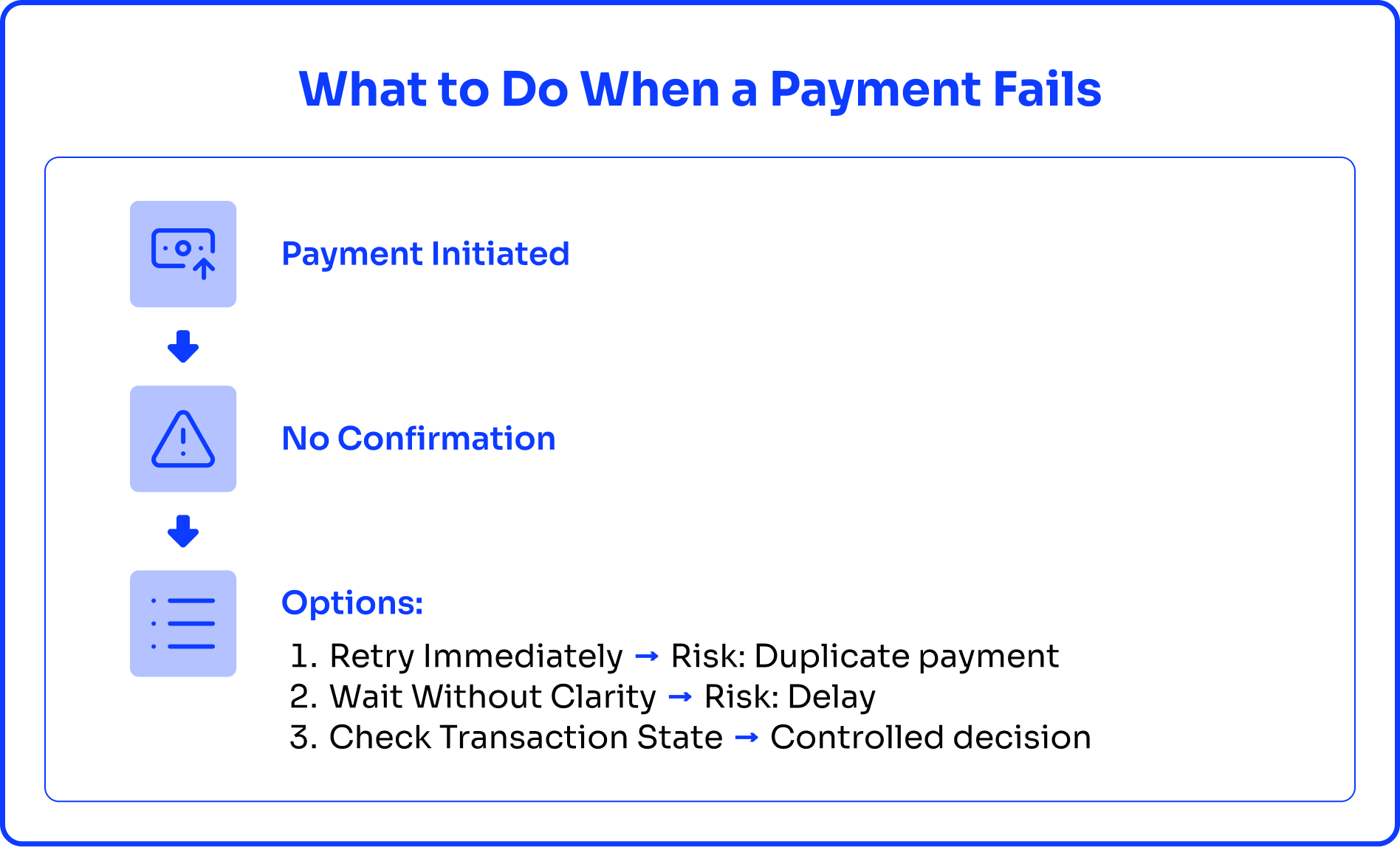
The core problem is the absence of a clear final state. Without certainty, any action risks duplication, delays, or disputes.
The Common Mistake: Retrying Immediately
The instinctive response is to retry the payment. An accountant may suggest, “Let us try again.” A founder often agrees, and the payment is resubmitted.
This usually results in:
- Duplicate payments
- Double debits
- Reconciliation confusion
- Vendor disputes
Retrying is not the problem. Retrying without knowing the previous transaction state is.
Operational Consequences of Failed Payments
When payments do not go through, the impact extends beyond finance teams:
- Vendor Coordination Disrupts – Without certainty, it is impossible to confirm payment status.
- Cash Position Becomes Unclear – Debits may have occurred, but there is no confirmation.
- Internal Workflow Slows – Teams wait for clarity before proceeding with subsequent tasks.
- Decision Fatigue Increases – Every new payment is approached cautiously, slowing operations further.
This is not a system failure; it is an operational bottleneck.
How Structured Businesses Handle Failed Payments
Mature organisations do not react immediately. They first establish the transaction state and then decide the next step. Their approach includes:
- Confirming if the debit is initiated or reversed
- Tracking the status of each payment at a transaction level
- Avoiding duplicate execution until confirmation
- Maintaining clarity across all accounts before retrying
Payments are treated as financial events with verifiable outcomes rather than simple actions.
When Systems Become Essential
Manual tracking works at low volumes. However, as the number of transactions, accounts, and dependencies grows, manual processes become unreliable.
India-Specific Payment Challenges
While the principles of payment state tracking are universal, Indian businesses face unique issues:
- UPI Timeouts: High transaction volumes or network congestion can leave payments pending.
- Bank Maintenance Windows: Scheduled updates may temporarily block transactions.
- NPCI Downtime: Occasional technical issues can delay UPI, IMPS, or NACH confirmations.
- Delayed Settlements: NEFT works in batches, so timing can affect when payments are credited.
These scenarios make it critical to verify transaction states before retrying or escalating payments.
At scale, businesses shift focus from asking, “Did the payment go through?” to asking, “What is the current state of each transaction?” Automated systems provide this visibility, reducing errors and operational delays.
How Platforms Like Yobo Support Payment Reliability
Platforms such as Yobo help businesses track the state of payments. They do not merely initiate transactions; they provide real-time updates on each payment’s status.
By monitoring each transaction:
- Teams can decide whether to wait, retry, or escalate
- Duplicate payments are avoided
- Operational workflows remain uninterrupted
This structured approach ensures payments are executed safely, reliably, and efficiently.
Conclusion
Payment failures are common, but their impact can be controlled. Acting without knowledge of the transaction state is where financial losses and operational inefficiencies occur.
The solution is simple: do not act on assumption. Act on the verified state of each payment. Organisations that adopt this discipline maintain cash flow, reduce disputes, and scale confidently.
FAQs
1. Why do payments fail even when funds are available?
Payments can be delayed by network issues, UPI timeouts, bank maintenance windows, or batch settlement schedules (like NEFT).
2. Can retrying a payment immediately cause problems?
Yes. In India, retrying a UPI or NEFT transaction without confirmation can cause duplicate debits and reconciliation errors.
3. How does tracking transaction state help?
Real-time tracking shows pending, completed, or reversed payments, even during UPI timeouts or bank maintenance, letting businesses act safely.
4. Is manual tracking reliable for large transaction volumes?
No. With multiple UPI/NEFT/IMPS transactions daily, manual monitoring slows operations and increases risk. Automated systems reduce errors and provide clarity.