
A Founder’s Monthly Reality
It is the 25th, and a small but growing business faces its usual challenge: vendor payments are due, payroll is approaching, and the accountant is sending NEFT screenshots over WhatsApp for approval. Multiple bank portals are open, and an Excel sheet tracks what has been paid and what is pending.
Nothing seems wrong, yet three hours disappear in preparation, approvals, and follow-ups. One vendor calls for confirmation; another needs a correction, and a third waits because the founder is in back-to-back meetings.
No major failure has happened, but time, focus, and small risks are quietly lost. Manual payment processing feels routine, which is why most businesses never calculate its true cost.
What seems like routine admin work hides a significant cost in leadership time, which is the first layer we need to understand.
Cost Layer One: Founder Time
Most small and mid-sized businesses process between 80 and 200 payments each month, with each transaction requiring a few minutes to prepare, review and approve. While this may seem trivial when considered individually, the cumulative effect can be significant.
To illustrate the time cost of manual payments, consider the following example:
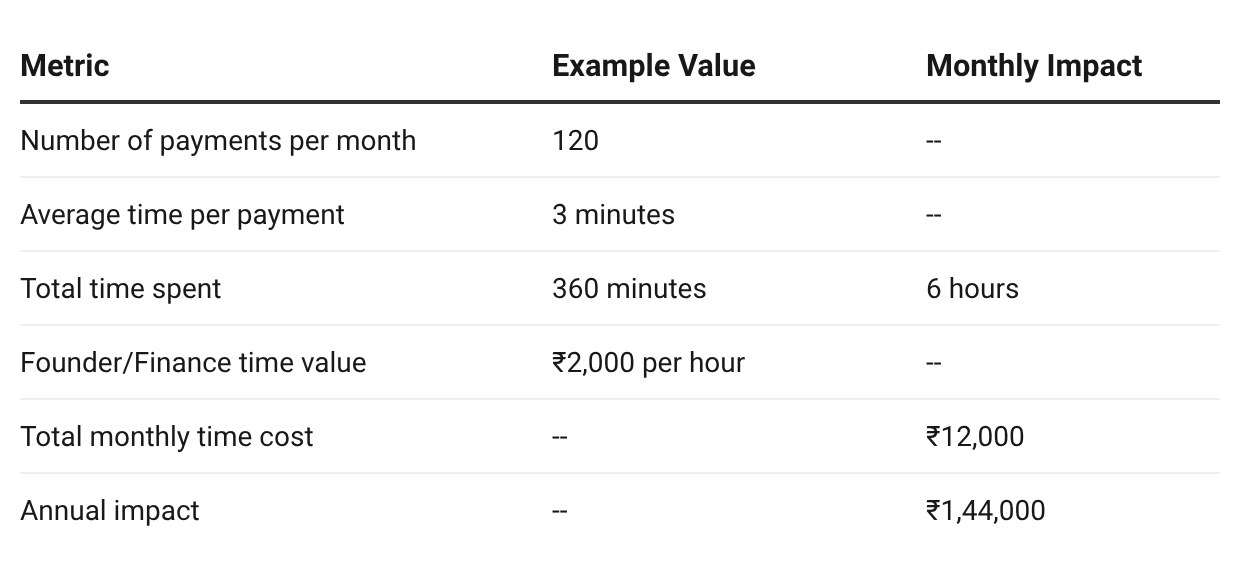
This table shows only the direct time spent. Follow-ups, corrections, and month-end checks are extra. Manual payments turn leadership time into admin work, costing hours that could be spent on strategic tasks.
Where Manual Payment Time Actually Goes
Even within this relatively simple workflow, time is not distributed evenly. A breakdown reveals where most of the effort is absorbed:
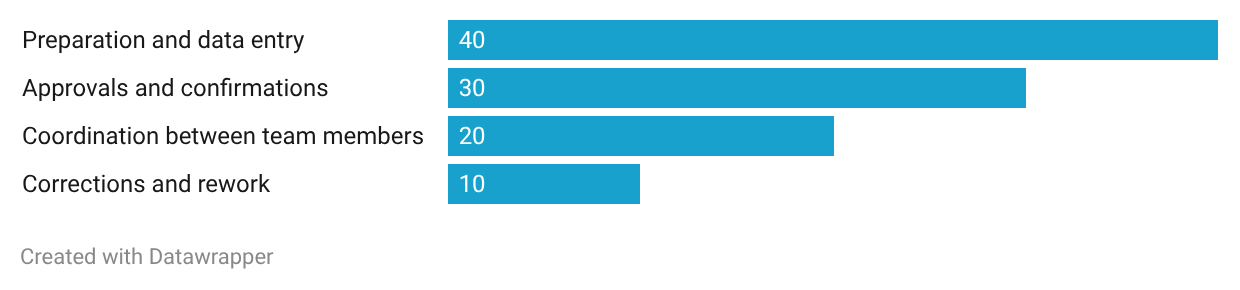
The above chart shows that most of the time is spent on preparation and approvals, while corrections and coordination quietly drain the team’s energy.
Cost Layer Two: Errors and Leakage
Manual processes increase the likelihood of mistakes, ranging from duplicate payments to incorrect beneficiary details, wrong amounts, missed approvals, and late settlements. Even a minor error rate can lead to substantial financial exposure.
For instance, consider a business with an annual payment volume of ₹5 crore:
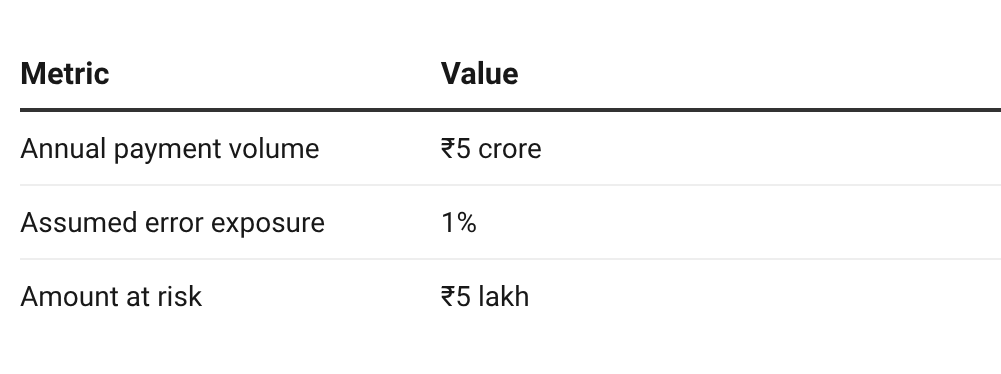
This table demonstrates that you do not need fraud to lose money; you only need friction in the workflow.
Cost Layer Three: Working Capital Distortion
Manual payment timing rarely aligns with the business’s liquidity planning. Payments may go out too early, reducing the benefit of agreed credit periods, or too late, creating tension with vendors and affecting long-term trust. Many teams lack a full view of balances across multiple accounts before releasing payments, which causes cash to leave the business reactively rather than strategically.
Without structured scheduling, payment execution distorts working capital efficiency, increasing cash pressure, and potentially leading to missed opportunities or unnecessary borrowing. Payment processing is therefore not merely an operational task; it directly influences the financial health of the business.
The Invisible Stress Cost
Manual approvals generate constant interruptions and operational friction. Accountants wait for responses in chat threads; founders receive repeated reminders, OTPs circulate across devices, and audit trails have to be reconstructed at month-end.
The entire system relies on memory and coordination instead of structure, which gradually leads to fatigue and reduced focus. Team members spend time chasing approvals, double-checking entries, and worrying about missing something. This cost does not appear in financial statements, yet it has a very real impact on efficiency and morale.
When Does Automation Pay for Itself?
Even a conservative assessment demonstrates that structured automation provides immediate returns.
A simple monthly cost estimate for manual payment processing looks like this:
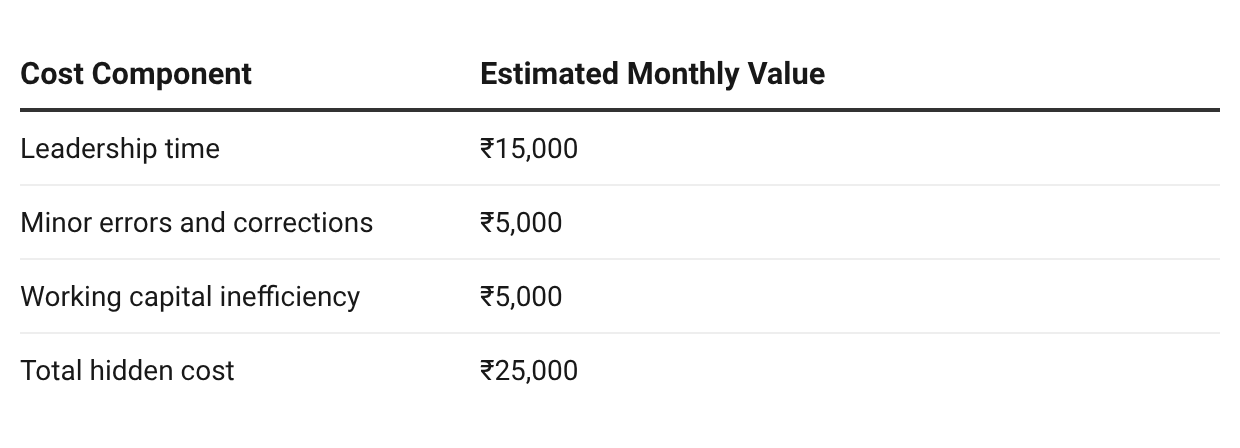
If a payment automation platform costs between ₹5,000 and ₹10,000 per month, the financial advantage is clear. Automation does not add expense; it reallocates inefficiency into structure, control, and predictability. Yobo. provides feasible yet efficient solutions for founders helping them manage their time by automating payments and maintaining financial discipline.
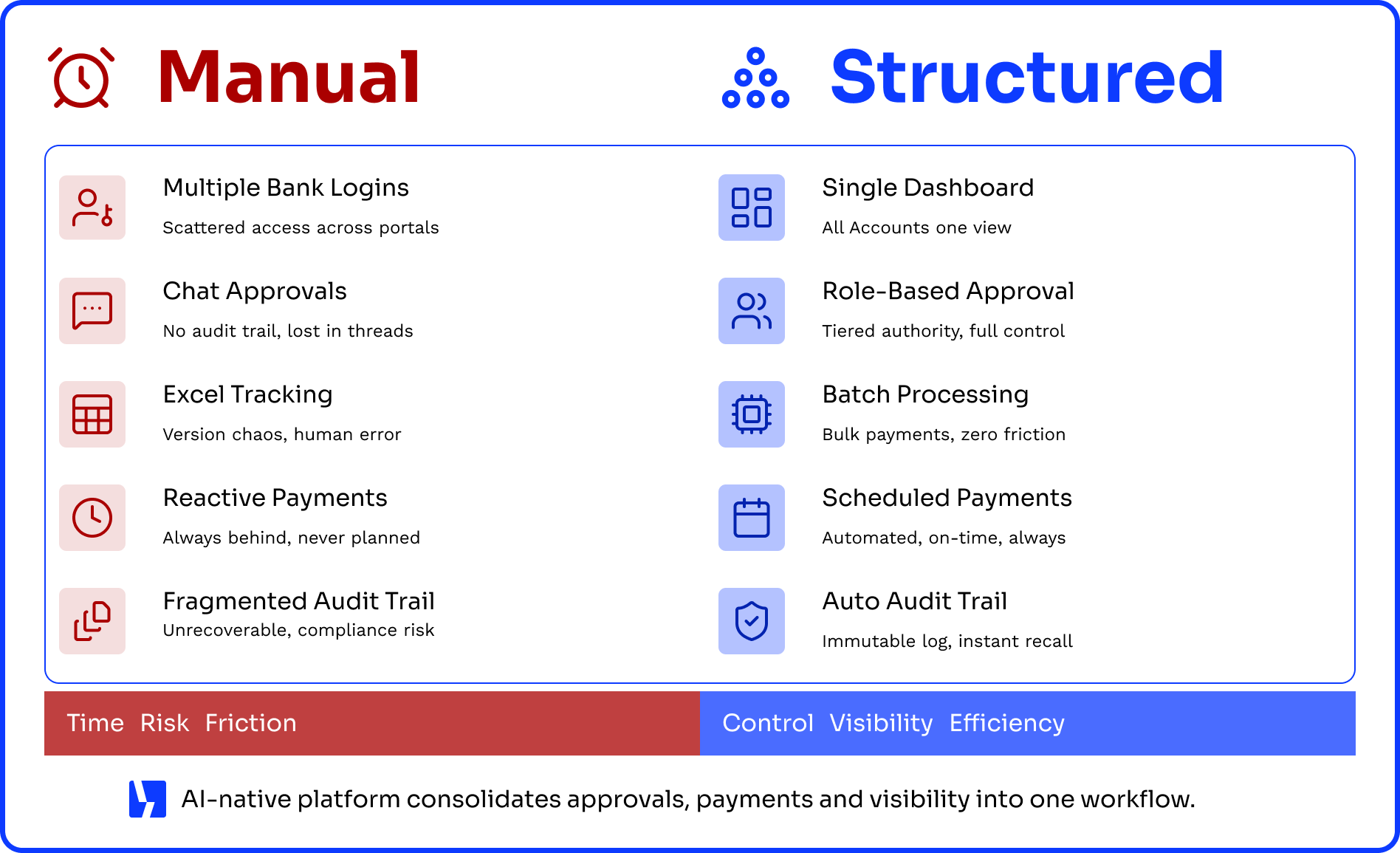
Final Takeaway
Manual payments often seem cheap because the costs are spread across time, errors, cash flow, and stress.
Together, these hidden costs add up: leadership time is lost, mistakes rise, cash flow suffers, and the team becomes stressed.
Automation is not just a convenience; it is a smart financial choice that saves time, protects capital, and makes operations more reliable.