
In financial services, speed and trust shape every user experience. Customers expect payments, account updates, portfolio changes, and alerts to happen in seconds. Behind that smooth experience sits a technology stack built for performance. For many modern fintech platforms, React and Go make an excellent combination.
React powers the user interface that customers see every day. Go runs the services that process data, move money, and keep operations reliable. Together, they help fintech products deliver fast, secure, and scalable real-time financial operations.
React creates fast and intuitive user journeys
A fintech platform lives or dies by user trust. If a balance takes too long to update or a transaction status feels unclear, confidence drops quickly. React helps solve this by creating responsive and interactive interfaces.
With React, teams can build dashboards that update instantly when balances change, trades complete, or payment requests move through approval steps. Components make it easy to reuse elements such as transaction tables, account cards, risk alerts, and charts across the platform. This keeps the experience consistent and easier to maintain.
React also supports state management patterns that help teams handle live financial data clearly. Whether users track invoices, reconcile accounts, or review cash flow, the interface can reflect the latest information without forcing them to refresh the page.
For product teams, this means faster feature delivery. For users, it means a smoother and more reliable journey.
Go keeps financial operations fast and dependable
While React handles the front end, Go powers the engine room.
Financial operations need systems that can process thousands of events at once. These may include payment confirmations, ledger updates, fraud checks, settlement messages, and notification workflows. Go is well suited for this because it is fast, efficient, and designed for concurrency.
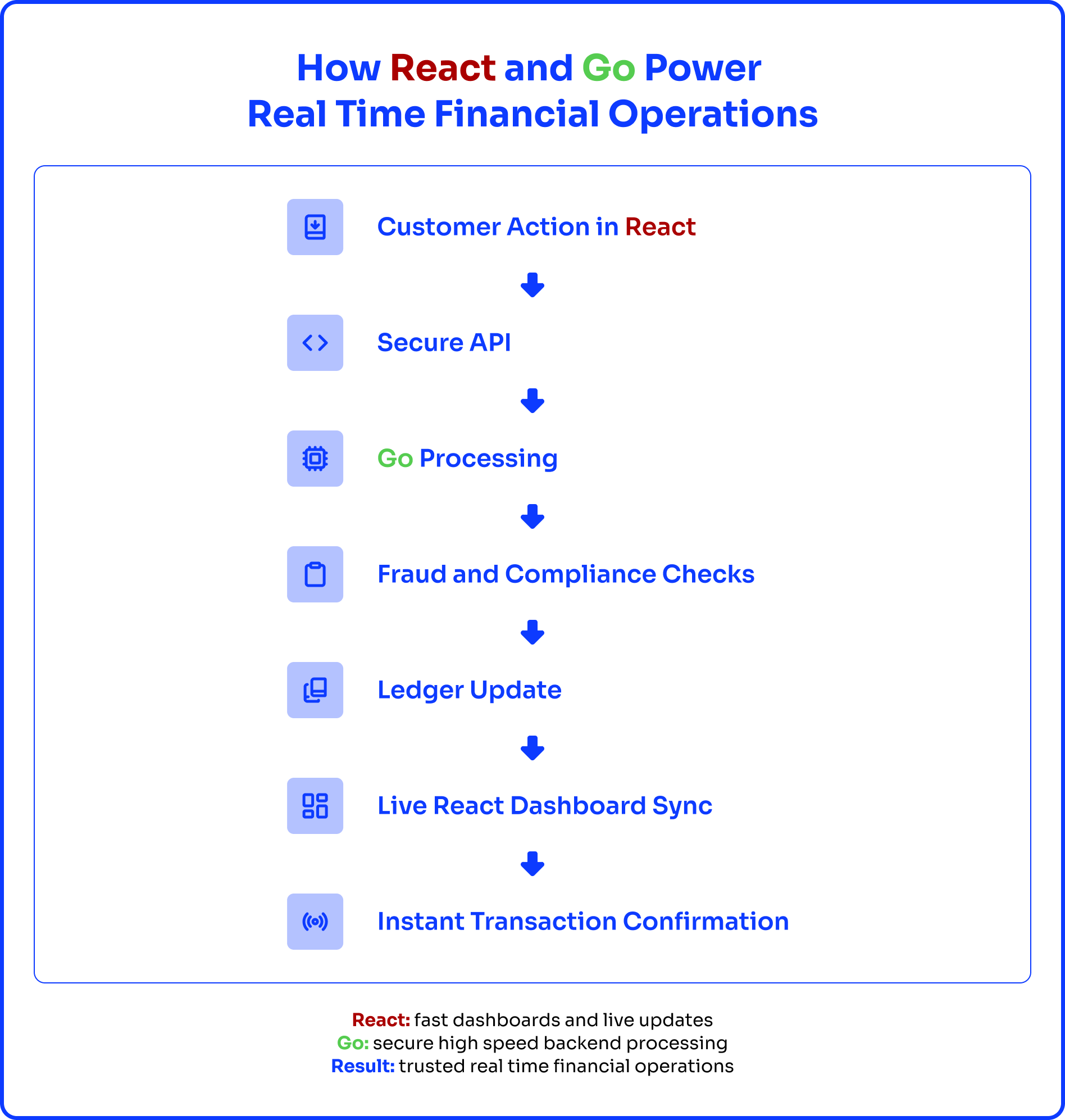
Go allows backend services to manage many requests at the same time without consuming excessive resources. This is especially valuable in fintech, where multiple workflows often happen together. A single payment action may trigger validation, risk scoring, compliance checks, ledger posting, and customer notifications in seconds.
Because Go compiles efficient machine code, it delivers strong performance under heavy loads. This helps platforms maintain low latency during peak transaction periods, such as payroll runs, market openings, or month-end reconciliation.
Its simplicity also helps engineering teams build clean services that are easier to test, review, and scale.
Real time architecture that supports trust
The real strength of React and Go comes from how well they work together in real-time architecture.
Go services can stream transaction updates, risk events, and account changes through APIs or WebSocket connections. React then renders those updates immediately in the customer dashboard. Users can see the status of a transfer move from pending to completed in real time, with no confusion.
This matters in fintech because transparency builds trust. Customers want clear visibility into every action, whether they are moving funds, approving expenses, or tracking settlements.
The combination also supports modular product growth. Teams can add services for lending, treasury, payments, or analytics without rebuilding the full platform. React keeps the experience unified, while Go services scale independently behind the scenes.
Built for the future of fintech
As fintech products grow, they need technology that supports both innovation and operational resilience. React and Go offer that balance.
React helps teams create polished, customer-friendly experiences that feel immediate and intuitive. Go ensures the backend can process complex financial workflows with speed and reliability.
For platforms focused on real-time financial operations, this stack does more than support the product. It has become a competitive advantage. It helps teams launch faster, scale with confidence, and deliver the trust that modern finance demands.
In the end, great fintech products are not just about moving money. They are about moving information instantly, clearly, and securely. That is exactly where React and Go shine.
FAQs
1) Why is real-time technology important in fintech?
It helps users see payments, balances, and alerts instantly. This builds trust and supports faster decisions.
2) How does React help the product experience?
React makes dashboards and workflows feel quick, simple, and easy to use, even with complex financial data.
3) Why do fintech teams choose Go for the backend?
Go handles high transaction volumes efficiently and keeps services stable during busy financial operations.
4) Can React and Go support future growth?
Yes, they help teams add new features and scale the platform without affecting speed or reliability.